 爪機版
爪機版 一爪一天地,一鳞一世界
#44826 主元素位面中的隱士:水晶龍 » 2009-02-10 19:05:54

回应:
下面那張是Mooncookie的圖喲~(我有好幾張這系列的呢~
謝謝影子咯~
#44827 龍的遷移史 » 2009-02-10 02:08:54

回应:
真乃強文也。。。
#44828 翻譯:Yurlunggur » 2009-02-09 23:52:48

回应:
詳細多了,也很好理解(比如之前我就一直想不明白“食物總是會跳回水裡去”到底是什麼情況)
看起來這本書值得一買
#44829 翻譯:Yurlunggur » 2009-02-09 23:00:17
回应:
《龍之物語》中有一段關於這位的解釋
敲上來~~~
阿奈姆蘭德東北部流傳着姐妹倆誤惹尤盧盧恩谷盧生氣的故事
被逐出故鄉、帶着孩子到海邊履行的姐妹二人,無意中來到尤盧盧恩谷盧棲息的清泉邊野營。他們為了做飯到泉裡取水,誤將經血流進泉裡。這在很多地方都是禁忌行為。受到冒犯的尤盧盧恩谷盧大怒,從泉裡出來懲罸姐妹二人。泉水暴漲淹沒周邊地區,形成大洪水。還下起暴雨襲擊人類。姐妹二人唱起祭祀儀式上唱的歌曲來阻止大雨,平息彩虹蛇的憤怒。尤盧盧恩谷盧只是在歌聲中才有所猶豫。當二人入睡時,(尤盧盧恩谷盧)張開大口把她們和孩子整個吞入肚內。
尤盧盧恩谷盧懲罸她們後心滿意足,重新回到泉裡。這也成為一次暴力鎮壓行為。彩虹蛇雲集在天上開會時,大家都在談論最近吃過的東西。尤盧盧恩谷盧感到很難實話實說,繼續隱瞞實情。但經不住再三追問,還是說漏了嘴。大家都指責他太過分,回到地面後又把姐妹二人和孩子吐了出來。但他們已經死亡。不過經綠色螞蟻一啃,又恢復了生氣,重新復活(吞進肚裏和再吐出來的行為是為了顯示彩虹蛇“偉大的母親”的性格)。
#44830 [灌水]太空堡壘飛越上海市區,市民爭相觀看 » 2009-02-09 00:40:00
回应:
嗯……如果減少些重覆鏡頭,效果能更好
話說天空中的太空堡壘是後期做上去的麼?看不清細節
#44831 龍的遷移史 » 2009-02-09 00:15:01
回应:
好調侃的文章啊,作者蠻油菜的
#44832 [灌水]太空堡壘飛越上海市區,市民爭相觀看 » 2009-02-08 03:04:19
回应:
這個雖然與本站主題基本無關,不過我們也不必生活得太過嚴肅,適當地灌一灌水,笑一笑是有益健康的。
我最初看這個視頻的時候完全被忽悠了,不過老外的想象力確實不錯!
http://www.youtube.com/v/b_xDpqSTNEQ&hl=zh_CN&fs=1
#44833 龍的遷移史 » 2009-02-07 23:50:18
回应:
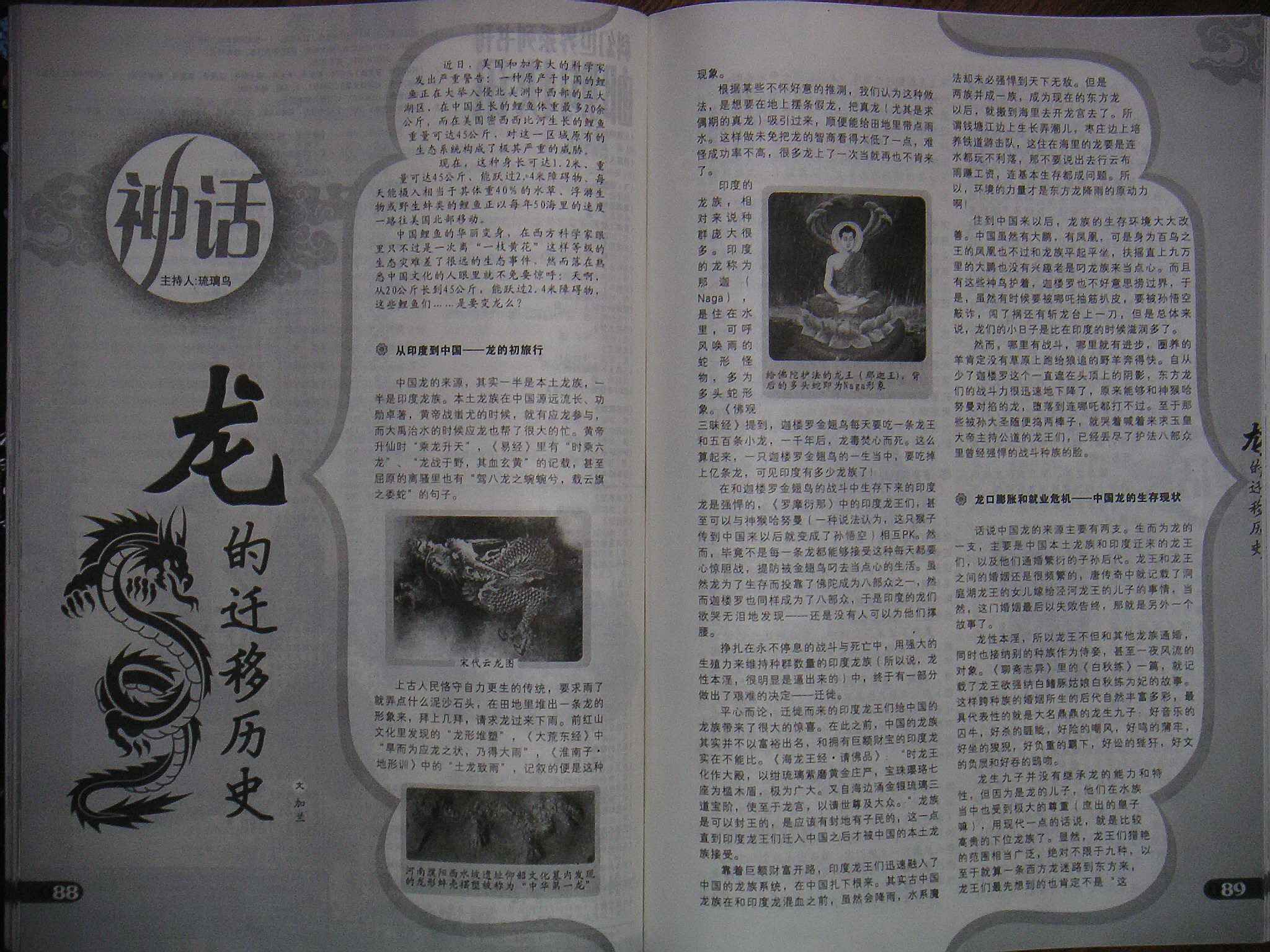
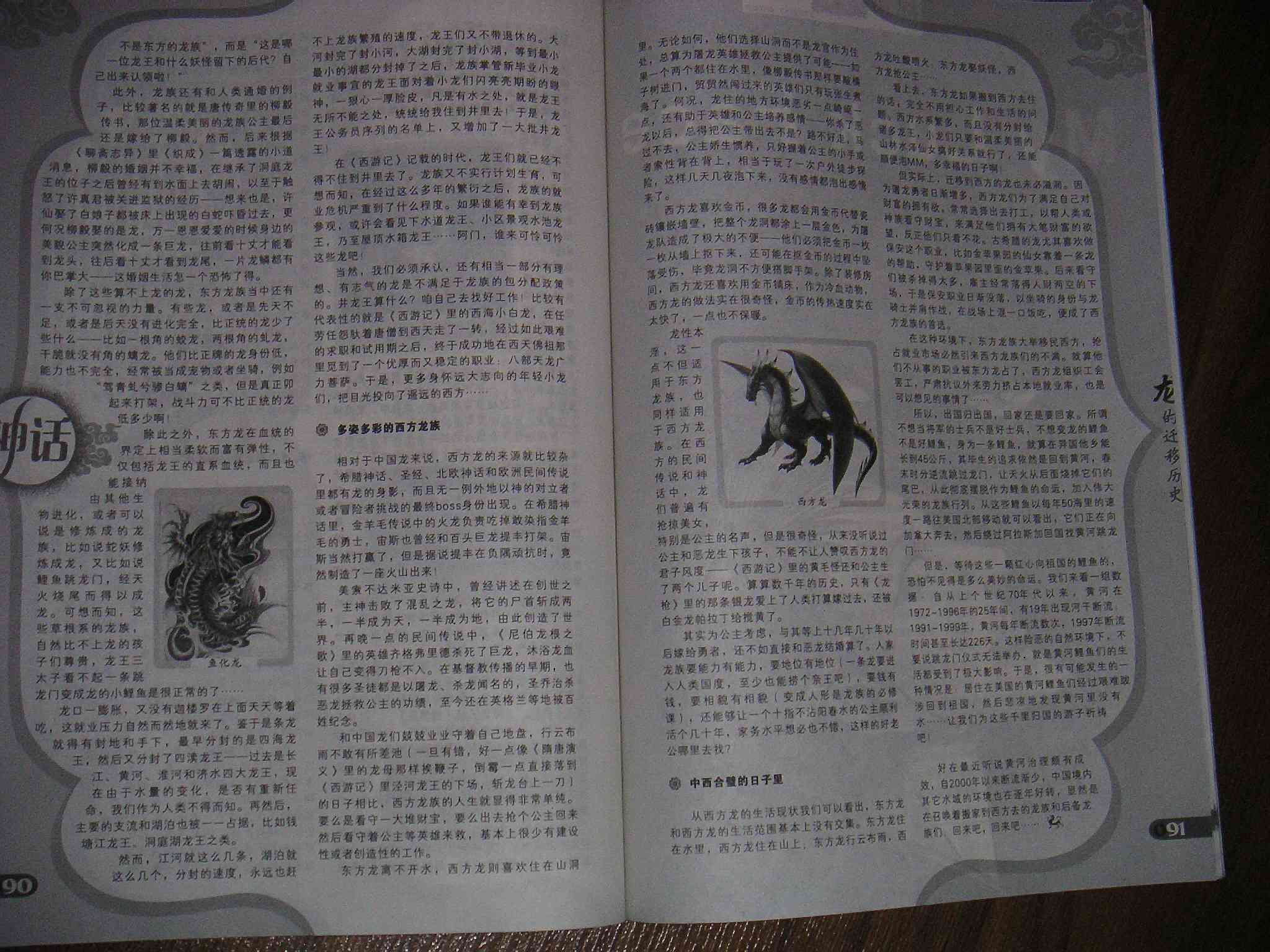
原本是《飛,奇幻世界》08年12月份中的一篇文章
因為寫的比較有趣,於是拿相機拍下來~
恩恩 龍性本淫……龍口膨脹和就業危機……找老公就找龍……
字太小的話存到硬碟上看,雖然有點模糊……
最后修改: 银月龙 (2010-06-25 09:19:46)
#44834 弗慄多Vritra » 2009-02-07 16:03:34
回应:
喔,這麼看來,和Ahi是同一個:http://yinglong.org/pedia/pedia/Ahi.html
已經合併到裏面了
最后修改: shiningdracon (2009-02-07 17:04:14)
#44835 Yam-Nahar » 2009-02-07 15:25:30
回应:
Tewhom又作Tehom
字面意思是“深”或“深淵” 。
在聖經中指原始水之源。
http://en.wikipedia.org/wiki/Tehom
#44836 Yam-Nahar » 2009-02-07 15:08:53
回应:
Yamm ,在迦南的文字中寫作Yam(希伯來文?)意思是“海” ,是一位烏嘎利特人的河流和海洋之神的名字。被授予Judge-Nahar(“Judge河”)這個稱號的同時,他還是埃洛希姆之一,或者說,是埃爾的兒子之一。埃洛希姆指地中海東部的衆神的代稱。而其他存在爭議的名稱,都被認為是根據一些已經損壞掉的石碑而得來的錯譯。暫且不管語言學上的重疊,從神學上看,這位神不屬於地中海東部周邊地區之後所形成的一神論體系,而屬於一個比一神論體系更加廣泛的、年代更加悠久的多神論體系。
嘗試更正如上
對於alternative names,維基百科裡有一段,說還有其他的名字Ya'a和 Yaw(來自希伯來聖經)還有Yah和Yahu(雅虎?來自猶太人的語言)。這幾個名字頗有爭議,alternative names指的就是那些名字吧
According to some, Yam was also called Ya'a or Yaw. Damaged text in KTU 1.2 iv has been interpreted by Mark S. Smith as describing a renaming of Yam from an original name Yaw.[2] The resemblance of the latter to the Tetragrammaton YHWH led to speculation over a possible connection between Yam and God of the Hebrew Bible. However, even if the reading is correct many scholars argue the names have different roots and reject the idea that they are related.[citation needed] Another suggested reading of the name is Ya'a and it has also been suggested as an early form of the divine name Yah, Yahu. Earlier archaeologists like Theophilus G. Pinches[3] quoted the research of Hommel, Professor of Semitic languages at Munich, who suggested "that this god Ya is another form of the name Ea...". By this theory Ya'a thus appears to have been a God of the waters, both salt (Yam) and fresh (Nahar), in some ways similar to the Mesopotamian God Ea.[4] This view has been supported in more recent times by archaeologists like Jean Bottero[5] and others,[6] although this is disputed by other scholars
最后修改: 银月龙 (2009-02-07 15:09:21)
#44837 弗慄多Vritra » 2009-02-07 14:41:45
回应:
弗慄多
弗慄多(梵文/天城文:वृत्र,Vritra/Vrtra),於早期吠陀神話中就已經登場的阿修羅神族的巨蛇納加(或巨龍),其名意為“掩蓋者”,是旱災的神格化。經典吠陀中又被稱為“Ahi”(阿悉),即“蛇”之意,傳說它擁有三個頭,是提婆族因陀羅的大敵之一。圍繞討伐弗慄多的故事隨着時間而産生了數個版本,亦見證了在三相神(梵天,毗濕奴及濕婆)信仰興起的同時因陀羅在印度教中地位的下降。
吠陀時期版本
根據經典梨俱吠陀1.154~1.32的記載,因陀羅剛出生不久就對弗慄多進行討伐,目的是為了解放世上所有被弗慄多堵住的水源。因陀羅先從工匠神陀濕多那裏得到武器金剛杵,並向毗濕奴請求划出一個戰場。毗濕奴在宇宙中踏出了三大步,所經過的地方構成了他所需要的戰場。戰前因陀羅先飲下大量的蘇摩酒以增強力量。他擊潰了弗慄多的九十九座堡壘。因陀羅在與弗慄多交戰的時候兩個下巴被擊碎,但接着因陀羅將它拋下山,弗慄多因撞到山下已經被粉碎的堡壘而死去。因陀羅因此得名“弗慄多罕”,即“殺死弗慄多者”。
現代印度地質學家嘗試以科學的角度對這個傳說進行解讀,B.P. Radhakrishna曾寫道:“於晚更新世時期,喜馬拉雅山脈的水源都是處於冰封狀態。直至氣候變暖,部分冰河開始破裂,裏面的大量冰塊滑落山下形成洪水,山腳的沖積平原被洪水淹沒……平原的居民將此現象看作成因陀羅神破冰解水的豐功偉業並創作詩詞歌頌他,在他們的眼中,喜馬拉雅山脈冰河緩慢地融化下流就有如蠕動的巨蛇(弗慄多)。”
並且梨俱吠陀6.61,第七句亦可以單獨地找到歌頌女神辯才天殺死弗慄多的詩句。如果Radhakrishna等地質學家對弗慄多傳說的解釋是正確的,那對辯才天的記載便可合理地理解成辯才天吸收了弗慄多的生命力(水)令自己“水源充沛”(辯才天Saraswati亦是印度聖河之名,盡管這條河在公元前2000~1700年因為地質變動而早已乾枯。)。
往世書及摩訶婆羅多版本
有關弗慄多的神話後來變成另一個版本,弗慄多被說是陀濕多為報復因陀羅殺害其子陀李司拉而創造的。弗慄多戰勝了因陀羅並將他吞下,衆神對弗慄多極其不滿,要求它吐出因陀羅。戰鬥依然在進行,因陀羅卻被迫逃走。毗濕奴與衆李習對他們進行調停,要求他們停下這場戰爭。毗濕奴要因陀羅發誓,他不可以用任何以金屬,木或石制物質襲擊弗慄多,不能用濕或干的武器,甚至不允許在日間或晚上進攻。因陀羅用計迴避這些規則,他用海浪的泡沫當作武器在黃昏時分殺死了弗慄多。
在另一個版本中,弗慄多(人形)原是毗濕奴的信徒(Bhakta),具有僧侶的種性,但因為欠缺虔誠心和帶有侵略性而遭受殺害。這個時候的弗慄多是已經被醜惡化的阿修羅族之首。他拋棄自己的法典,對提婆族宣戰。他的力量讓因陀羅為首的衆提婆神不無畏懼,他們向毗濕奴求助,毗濕奴就解釋在正常的情況下弗慄多是無法被擊敗的,唯一能有效對付他的武器是一位聖人的骨頭製作的武器。當衆神找到毗濕奴指示的這位李習——達呵池——的時候,他欣然地答應為了善,而獻出自己全部的骨頭。提婆們收集起骨頭,因陀羅用這些骨頭做出武器金剛杵之後,再次與弗慄多交手,大戰360日後弗慄多終於被殺死。但不論是殺害了Trisiras或僧侶級弗慄多的版本,因陀羅都必須背負“弒僧侶”的罪名而遁世,那忽沙在同時就領受引召取代了因陀羅的席位。
印度神話中像這種需要在付合某種特定條件下才能被打敗的神話人物的情節,亦可在討伐拉瓦那(見經典羅摩衍那的敘述)及希蘭亞卡西普的故事中被找到。
先聲明不是我翻譯的,而是直接COPY自維基百科中文版,並更正幾處錯誤。
http://zh.wikipedia.org/wiki/%E5%BC%97%E6%A0%97%E5%A4%9A
而這段也是直接翻譯自英文版。英文原文見
http://en.wikipedia.org/wiki/Vritra
#44838 Wollunqua / Warramunga / Wallunquain » 2009-02-07 14:31:33
回应:
又一條虹蛇,澳大利亞究竟有多少條虹蛇呀
#44839 Yam-Nahar » 2009-02-07 14:11:13
回应:
關於第一段的翻譯:
Yamm, from the Canaanite word , (Hebrew ????) meaning "Sea", is one name of the Ugaritic god of Rivers and Sea. Also titled Judge Nahar ("Judge River"), he is also one of the 'ilhm (Elohim) or sons of El, the name given to the Levantine pantheon. Others dispute the existence of the alternative names, claiming it is a mistranslation of a damaged tablet. Despite linguistic overlap, theologically this god is not a part of the later subregional monotheistic theology, but rather is part of a broader and archaic Levantine polytheism.
Yamm ,在迦南的文字中寫作Yam(希伯來文?)意思是“海” ,是一位烏嘎利特人的河流和海洋之神的名字。被授予Judge-Nahar(“Judge河”)這個稱號的同時,他還是' ilhm (埃洛希姆)之一,而且還是埃爾的兒子,在地中海沿岸居民的傳說當中也是這個名字。而其他存在爭議的名稱,都被認為是根據一些已經損壞掉的石碑而得來的錯譯。這不僅僅是語言上的一種巧合,在神學上的神這個含義,不是相臨近的地區所形成的一神教體系,而是一個更廣義,更古老的多神體系。(銀月:最後一句有疑問)
我覺得"the name given to the Levantine pantheon"的意思是“地中海東部的衆神的代稱為Elohim”(pantheon這個詞我感覺應該取這個意思:the gods of a particular mythology considered collectively.)當然,Elohim都是El的子孫,El創造了Elohim。
最後一句是不是可以這樣看:“暫且不管語言學上的重疊,從神學上看,這位神不屬於周邊地區之後所形成的一神論體系,卻屬於一個廣泛的、古老的地中海東部多神論體系”
我不理解那個“alternative names”指代的是什麼,是在說還有其他名字呢,還是說Yamm、Judge Nahar、Elohim這幾個名字呢?“Others dispute the existence of the alternative names”是不是說其他學者對這多個名字的存在有爭議,認為是源自對破損石碑的錯誤翻譯?
#44840 Yam-Nahar » 2009-02-07 12:45:43
回应:
一些補充:
來源:http://en.wikipedia.org/wiki/El_(god)
El (希伯來語: אל; 希臘語: Ελ) al, iah, yah 或者 Eli, 是一個西部閃米特人的詞彙,表示‘力量’。
意為:至高的力量、神、上帝、造物主。
來源:http://en.wikipedia.org/wiki/Elohim_(gods)
Elohim表示El的子孫們,El創造了Elohim,El是衆神之父
#44841 Wivre / Guivre » 2009-02-07 12:06:29
回应:
那個連接似乎是個在綫代理?我打不開。是這個詞條吧?http://en.wikipedia.org/wiki/Wyvern
#44842 Wivre / Guivre » 2009-02-07 11:44:05
回应:
Wivren是Wyvern的另一種寫法,
http://yinglong.org/pedia/pedia/Wyvern.html
不過Wyvern詞條有待完善
維基百科:http://proxytoy.com/index.php?hl=f5&q=uggc%3A%2F%2Fra.jvxvcrqvn.bet%2Fjvxv%2FJlirea
最后修改: 银月龙 (2009-02-07 11:44:26)
#44843 Wivre / Guivre » 2009-02-07 11:31:43
回应:
Wivre / Guivre
* Related to the Wyvern
* Wingless
Would only really attack if the target had clothes on. Moral of the story - if you wanted to live, get naked and it will run away. (I wonder if this applied only to the women .... )
他和雙足飛龍有血緣關係。無翼。
他只會攻擊穿衣服的生物(我可以用這個表情嗎?囧!!!)。有寓言(?)這麼說道:如果你遭到了他的攻擊,立刻將身上的衣服脫下來,這樣他就會逃跑。(我不知道這是否僅適用於婦女.... )
最后修改: 银月龙 (2009-02-07 11:41:19)
#44844 Wode Worm of Linton » 2009-02-07 11:17:18
回应:
來自dracopedia
Wode Worm of Linton
(English Legend)
The Wode Worm of Linton was a monstrous worm from North England but was slain with the aid of some peat.
The hero managed to stave its rampaging in the region by attacking it and, whilst its mouth was open, shoving a burning block of peat down its throat. Once lit, peat is very difficult to extinguish, and the worm burned to death from inside.
在北英格蘭的傳說中,The Wode Worm of Linton是一條令人恐懼的龍,但是他卻被泥炭殺死。
一位英雄試圖用戰鬥來阻止它在這個地區的肆虐行為,他成功地讓它的嘴張開,他把一些燃燒着的泥炭塊推進它的咽喉中。泥炭塊一旦點燃,就很難撲滅的。於是它被這些泥炭活活燒死。
#44845 Wollunqua / Warramunga / Wallunquain » 2009-02-07 10:53:47
回应:
來自 Encyclopedia Mythica
by Micha F. Lindemans
The Aboriginal giant snake which is associated with the rainbow and worshipped a creator of life. The snake emerged from a lake in the Murschison Mountains where the life-bringing rains are collected.
在澳大利亞原住民的神話當中是一條巨大的蛇,他象徵著彩虹,同時被尊為生命的創造者。他居住在Murschison山,這座山是一個可以帶來生命的雨水的聚集地。
#44846 Wollunqua / Warramunga / Wallunquain » 2009-02-07 10:52:41
回应:
來自維基百科
In Australian aboriginal mythology, Wollunqua (or Wollunka, Wollunkua) is a snake-god of rain and fertility, who emerged from a watering hole in the Murschison Mountains. He is said[Please name specific person or group] to be many miles long.
在澳大利亞土著神話當中,Wollunqua(又寫作Wollunka,Wollunkua)是掌管降雨和生育的蛇神,有人在Murschison山的一個被水淹沒的洞穴中發現過他的蹤跡。據說,他長達數英裡。
#44847 Wollunqua / Warramunga / Wallunquain » 2009-02-07 10:51:33
回应:
Wollunqua / Warramunga / Wallunquain / Great Rainbow Snake
* Appears in the art and ceremonies of the aborigines.
* One legend associates Wollunqua with Mumumanugara, but few specifics are available.
* Is considered a creator of life
* Blind
* Symbol of the spring
他出現在澳大利亞原住民的一些藝術作品和儀式當中。一些人認為Wollunqua與Mumumanugara有很深遠的淵源 ,但鮮有具體的記載。他被視為生命的創造者,同時也是春天的象徵。他是瞎的。
#44848 Yam-Nahar » 2009-02-07 07:59:38
回应:
#44849 刻克洛普斯 » 2009-02-06 23:57:21
回应:
感謝銀月對翻譯提出的建議:
Poseidon, in a rare show of magnanimity, decided to grant his gift regardless, although its nature was initially misunderstood: it was meant to represent sea power, which Athens was to exercise gloriously in the future.
波塞冬難得地顯現出如此寬宏大量,他決定就算他輸掉了這場博弈,也要將這份禮物送給雅典,雖然一開始雅典人誤解了這份禮物的含義:這份禮物就是海的控制力,而雅典人可以在將來(?)光榮地運用它。
#44850 Yam-Nahar » 2009-02-06 23:26:01
回应:
在維基百科中的結果
Yamm, from the Canaanite word , (Hebrew ????) meaning "Sea", is one name of the Ugaritic god of Rivers and Sea. Also titled Judge Nahar ("Judge River"), he is also one of the 'ilhm (Elohim) or sons of El, the name given to the Levantine pantheon. Others dispute the existence of the alternative names, claiming it is a mistranslation of a damaged tablet. Despite linguistic overlap, theologically this god is not a part of the later subregional monotheistic theology, but rather is part of a broader and archaic Levantine polytheism.
Yamm is the deity of the primordial chaos and represents the power of the sea untamed and raging; he is seen as ruling tempests and the disasters they wreak. The gods cast out Yam from the heavenly mountain Sappan (modern Jebel Aqra; "Sappan" is cognate to Tsephon (Tsion)). The seven-headed dragon Lotan is associated closely with him and the serpent is frequently used to describe him.
Of all the gods, despite being the champion of El, Yam holds special hostility against Baal Hadad, son of Dagon. Yam is a deity of the sea and his palace is in the abyss associated with the depths, or Biblical tehwom, of the oceans. (This is not to be confused with the abode of Mot, the ruler of the netherworlds.) In Ugaritic texts, Yam's special enemy Hadad is also known as the "king of heaven" and the "first born son" of El, whom ancient Greeks identified with their god Kronos, just as Baal was identified with Zeus, Yam with Poseidon and Mot with Hades. Yam wished to become the Lord god in his place. In turns the two beings kill each other, yet Hadad is resurrected and Yam also returns. Some authors have suggested that these tales reflect the experience of seasonal cycles in the Levant.
Yamm ,在迦南的文字中寫作Yam(希伯來文?)意思是“海” ,是一位烏嘎利特人的河流和海洋之神的名字。被授予Judge-Nahar(“Judge河”)這個稱號的同時,他還是' ilhm (埃洛希姆)之一,而且還是埃爾的兒子,在地中海沿岸居民的傳說當中也是這個名字。而其他存在爭議的名稱,都被認為是根據一些已經損壞掉的石碑而得來的錯譯。這不僅僅是語言上的一種巧合,在神學上的神這個含義,不是相臨近的地區所形成的一神教體系,而是一個更廣義,更古老的多神體系。(銀月:最後一句有疑問)
Yam是原始混亂之神,他擁有可以駕馭桀驁不馴的海的力量;他被視為是帶來暴風雨和災害的象徵。Yam被埃爾從天堂山Sappan攆下去(今Aqra山,Sappan和Tsephon ( Tsion )是同源 )。七頭龍Lotan的形象與它相近,通常用Lotan來描述Yam。
在所有的神當中,盡管他是埃爾的擁護者,Yam卻特別仇視達貢的兒子巴爾(Baal Hadad)。Yam是海之神,他的宮殿是在海中的一個極深的深淵中,象徵著地獄(銀月:求解),或者說是聖經中的tehwom(銀月:求解)。(不過不要將它和陰間的統治者——Mot的居所混淆。)在烏嘎利特的傳說中,Yam的死對頭巴爾也稱為“衆神之神”和埃爾的“第一個出生的兒子” ,古希臘人的傳說中,埃爾等同於克羅諾斯,正如巴爾的地位等同於希臘神話中的宙斯,Yam的地位等同於波塞冬,Mot的地位等同於哈迪斯那樣。Yam希望成為掌管這片土地的神。這兩個神輪流攻擊對方,你來我往不亦樂乎。有些學者認為,這些故事反映了地中海東部周期性的季節變化。
最后修改: 银月龙 (2009-02-07 15:22:21)